
Part 4 of What Companies Should do During a Media Crisis: Communicating with (and through) the Media

Part 4 of What Companies Should do During a Media Crisis: Communicating with (and through) the Media

In some ways, talking to customers and the public through the media is the easiest part of a crisis.  It’s also one of the most risky as it relates to protecting your company.  The job of media outlets is to share the information of what’s happening with the public, but not necessarily to share that information in the way you want.

Assuming you’ve already read through Part 1 of this series and already have your simplified and clarified message finalized, let’s jump right in to some best practices for talking to media during an emergency.

Six best practices for talking to media during a crisis: 

  1. Designate One Spokesperson. Answers and statements to media are best when they funnel through one person to ensure consistency.  When it comes to the media quoting the company, you’ll be much happier in the end if the same person is quoted in every interview. That said, every media outlet will contact your company separately for a comment.  If you’re planning a press conference, let other communications team members answer calls and emails, and tell reporters to attend the media briefing for more information. The more time the spokesperson can spend doing interviews instead of scheduling interviews the better.
  2. Acknowledge Questions Quickly. You don’t need to know the answers, the public just needs to know you’re working on getting the answers.  Failure to respond to media quickly and acknowledge an issue implies the company doesn’t know, doesn’t care, or doesn’t know what to do.
  3. Respect Their Timeline, Not Your Own. Reporters have deadlines and they don’t work for you. During a crisis, think of it like you work for them. You can’t make a bad story go away, but you can make it less severe. If you make the reporter’s job harder, why would they give your company any breaks?  The easiest way to stay on a reporter’s good side is to ask them what time they need an answer by, and if at all possible get them an answer before the time they request. If you know you aren’t going to have an answer in time, tell them.  They will understand it takes time to get answers and it won’t always be possible by their deadline but they still have a story to write or tell regardless. If you tell them late it makes it harder for them to write or tell the story, and you run the risk they’ll take that extra stress out on you and your company in the story they tell.
  4. Don’t Let the CEO or Other Key Leaders Speak. This recommendation will be a surprise to many, but I believe that a company leader should never be the one to explain what went wrong immediately as a crisis is occurring.  Let your hired PR firm be on camera as the bad guy explaining the problem (that’s one of the services we offer for our clients to help protect them).  Only after we have an answer and a solution should the CEO or leadership talk to reporters, so they can take credit for fixing the problem instead of being seen AS the problem.
  5. Crow Tastes Better Warm Than Cold. Mistakes happen.  If you’re going to need to accept blame eventually, apologize for the mistake quickly. Why suffer extra news cycles of damage when you can shorten the window and focus on fixing the problem.
  6. Show how you fixed the problem. In the days and weeks after the crisis, share your story of how you’re fixing the problem and how you’re making sure a similar mistake never happens again.  If you have new technology or equipment to avoid a future problem, announce it and add it to your website so people know the issue has been resolved. Post “thank you” notes and comments from once unhappy customers demonstrating your commitment to making things right.  Highlight employees that went above and beyond to fix the problem and protect customers. Create a case study showing your commitment and ability to make changes that protect and help your customers and the public.  You won’t be able to erase the initial mistake, but you can celebrate your efforts to fix it.

Finally, I would argue that during a crisis you need the media a lot more than they need you.  They’re telling the story whether you help them or not.  If you want them telling the story in the least damaging way, you need to respect them, and use them to share the message you want accepted by your employees, the public and your customers.

-written by Josh Weiss
Part 3 of What Companies Should Do During a Media Crisis: Communicating to your Impacted Customers and Supporters

Part 3 of What Companies Should Do During a Media Crisis: Communicating to your Impacted Customers and Supporters

The hardest and most important communications you have to handle during a crisis is to set the right tone and be responsive when sharing information to your supporters and any impacted customers.

Your customers are the ones who ultimately hold your company’s destiny in their hands.  If you want to weather the storm, the easiest way is to protect and save what you already have secured.

Assuming you’ve already read through Part 1 of this series and already have your simplified and clarified message finalized, let’s discuss the next section of this four-part series.  How to communicate with impacted customers and your supporters during a crisis.  

Tips for talking to impacted customers:

Be Honest and Be Direct.  People will be upset- don’t ignore or belittle that anger.  Be humble and empathetic in your wording, but also tell customers what to do or what to expect.  Provide usable information in the first few sentences, don’t bury the detail halfway through your statement.  Someone who’s stressed by your company shouldn’t have to search a long document to find updates or answers.

Provide Expectations and Instructions, Even When You Don’t Know the Answer. Even if you don’t yet have all the answers, acknowledge the issue and explain that you’re working on an answer. A simple statement on your website and SM channels can help, such as:  We are aware of the issue and are working on a solution.  We will provide an update with additional information at 3pm today, or earlier if possible.

Move the Issue Off Your Main Page.  If you’ll need to communicate lots of information over time, or will be giving lots of updates over several days, create a secondary website or social media page to separate angry customers from unknowing or unimpacted customers.

Respond to Social Media Posts.  Angry customers will make lots of posts on your social media pages. Create a series of short responses that can be used. One response may simply be that you’re working on a resolution to the issue and that the company will provide an update as soon as it can.  Another might be to direct impacted customers to another page for more information, updates and how the company plans to help impacted customers. Ultimately, people want to be acknowledged, and others will see you responded.

Accept that media is a conduit to talk to upset customers.  Upset customers during a crisis will be watching media to see how you respond to the crisis.  Therefore, your response needs to have them in mind.  If customers need to do something as a result of the crisis, tell the media what customers should do and use them to help give instructions.  I’ll get more in to talking to the media in Part 4 of this series.

For the most part, people can accept that mistakes occur, and that not everything is in our control.  Customers just want to know you’re genuine in your desire to fix the problem and truly do apologize and accept responsibility when it’s expected.  If you handle the crisis well, and your customers are content with how you handled everything, they may become even more loyal to you and your brand, knowing that they can count on you to do what’s right even when it’s not easy.

-written by Josh Weiss

Part 2 of What Companies Should do During a Media Crisis: Communicating Internally to Your Staff During a Crisis

Part 2 of What Companies Should do During a Media Crisis: Communicating Internally to Your Staff During a Crisis

A crisis doesn’t only effect customers, it directly effects your staff. It’s your staff that has to communicate with angry, scared customers – calming their fears and resolving their problems. It’s your staff that needs to keep their cool, show empathy and have crazy amounts of patience.

Like a sports coach, leaders need to give their team the strategy and direction to implement during a crisis.

In Part 1 of this four-part series we focused on simplifying and clarifying your goals as a formal statement that all parties can focus on during a crisis.  Now let’s focus on the audience that often gets ignored and forgotten during a crisis—your own employees.

But leadership often forgets that employees themselves are often scared during a crisis. They’re scared for their jobs, they’re scared of the extra work that will be required of them, and they’re afraid of not knowing what’s really going on.

There are some important steps company leadership must take (to keep employees on their side).

Leadership needs to be seen and heard, and employees need to be told what the company is committed to doing, and how they’ll be acting in the future (see part one of this series on simplifying and clarifying your goals during a crisis).

  • Hold small group meetings with team leaders. Very quickly (within hours) have a series of small group meetings with your senior team leaders.  Hold the meeting in-person if possible, but even a video streamed meeting or conference call will work.  Tell them what you’re doing, and what they should be telling their teams.  Their staff will be looking to their supervisors for instructions, and nothing is scarier to morale that managers not knowing what to do or if they themselves look scared.  A five minute meeting can make all the difference to your teams. Make the time.
  • Walk among the workers. Have leadership walk through the cubicles and offices thanking employees and portraying confidence- even if leadership doesn’t completely feel that confidence.  If you’re in multiple locations this may not be possible, but have local leaders do the walk-around instead.  When leadership smiles and displays confidence in employees it goes a long way for morale.
  • Have your talking points and be prepared to repeat them. The key points should all revolve around the simplified, clarified statement you set (again, see Part 1 of this series).  Stay on your talking points, even when asked lots of specific questions. Stick to the main points while acknowledging that the question is valid but that you’ll make an announcement to all employees about it soon to ensure everyone has the same information at the same time to avoid more rumors or confusion.
  • Host a town hall in person or live streaming. After the initial shock, and after you have time to digest the core issues, it’s time to hold a large team meeting (or series of meetings).  Your staff may be scared, but you need to show your confidence in them.  Tell them that you know that this isn’t easy for them, but that you appreciate them. Tell them that your leadership team will support them and do all they can to help resolve the problem. Answer what questions you can, but only share information you want media or the public to hear. Even if it’s only intended for employees, all it takes is one scared or angry employee to talk to someone they shouldn’t.
  • Demonstrate your appreciation. Maybe you can buy breakfast or lunch for your teams as a simple thank you.  Maybe you can hand-write a handful of letters to key team members at all levels telling them they are appreciated.  Maybe you can send a group email to a select team saying that you appreciate their efforts.  Simple acknowledgements and thank yous go a long way in keeping staff on your side.

Your staff is already going to have their hands full dealing with customers and the public, but if you lose the support and confidence in your own employees your task becomes nearly impossible. By investing the time to communicate and solidify support of your internal teams, your likelihood of quickly winning back customers and the public support goes up significantly.

-Written by Josh Weiss

The PR crisis for your company has already begun, so what should you do? Part 1: Simplify and Clarify Your Message.

The PR crisis for your company has already begun, so what should you do? Part 1: Simplify and Clarify Your Message.

Ready Fire Aim. That’s how too many companies handle a crisis.  They respond before they know what their message is, and they end up saying the wrong thing to the wrong audience.

It’s easier if you plan for a crisis in advance so you can execute your strategy when needed, but a lot of companies find themselves unprepared during an emergency. For this four-part blog series, let’s focus on four topics of what to do after the crisis has already started.

Part 1:  Simplify and Clarify Your Message

Part 2:  Internal Communication (i.e. to staff, investors, etc.)

Part 3: Communicating with impacted customers and your supporters

Part 4: External Communications with reporters and the public

Let’s jump right in to Part 1, shall we?

When a crisis occurs, companies tend to make one of two opposite, but equally painful, mistakes.

One mistake is being too afraid to say anything at all, and by taking too long to respond the company fails to stop the bleeding before the damage is complete. A quick acknowledgment and action by the company is essential to ending a crisis.  The more news cycles the company waits to show they care and are trying to fix the problem, the worse it will be.

The other mistake is speaking too quickly without an organized strategy or a designated spokesperson from whom all statements will be controlled and consistent. A company can look pretty bad when different spokespeople contradict one another. It only leads to more confusion and issues to resolve. It also looks horrible when a statement is made, but only hours or days later the company needs to backtrack because the company’s desired message or strategy has changed.

Both of these mistakes (and the inconsistencies they create) are not due to ineptitude by any individuals. Rather, it’s simply a lack of a simple message and simple direction from the top.  In the middle of a media crisis, it’s too late to form a committee and discuss options.  Leadership needs to act quickly to calm the storm, but clarity and consistency is also needed.

Simplify and Clarify Your Message

One of the first things company leaders need to quickly decide are a few core message points from which all statements and actions will revolve around – no matter who is speaking or listening.  The key is clarity and direction.  The statement should clearly and simply state what the company is focused on during the crisis, and what the company will do after the initial crisis is over.

For example, say your healthcare organization has a major HIPPA violation.  An example of your core message points may be:

  • We will take care of our patients impacted by the violation
  • We will investigate and take action where appropriate
  • We will redouble all efforts to prevent any future similar violation

These statements may not seem very deep, but they’re very powerful.  They’re a promise allowing all parties, internal and external, to set their expectation.  They become the mile markers for which the overall response can be judged.

The statement lets those who are impacted, the public in general, and the media know the company cares and is working on proper resolutions. It’s hard to hate someone that’s trying to help. It may not stop anger or fear, but there’s comfort in knowing the issue is not being ignored and the company has a plan of what to do to fix it.

To company spokespeople, it gives clear statements to convey to anyone that will listen.  The statements are general enough that they can be given quickly to media, even before all the facts are known.  It shows that the company isn’t ignoring the crisis, or the anger or fear it might create. It shows the company cares.  It also creates a clear path to show the public in the future that the company followed through on its commitment, wherever that path might lead.

These simple but direct statements also give internal guidance to employees on how they are supposed proceed in the immediate aftermath of the crisis.  It also points in the direction where the light at the tunnel will (eventually) appear.

The first statement, to take care of the patients effected, is something employees can start doing immediately.  The second statement lets internal teams know they need to investigate what happened and the third statement instructs employees to figure out if anything needs to change internally to make sure such a violation doesn’t occur again.

Ultimately, during any crisis there’s lots of details and nuance that to insiders seem important. As company leaders, you need that info to evaluate the details and decide how to fix the problem, but these details aren’t important to the general public.  From a message and direction standpoint, the best thing a company can do to protect its brand image and minimize the damage is to simplify and clarify the goals into a statement that is easy for everyone to understand and rally around.

– – written by Josh Weiss, President, 10 to 1 Public Relations

Our Favorite Business (not political or Hollywood) PR Crisis Examples for 2017

by Josh Weiss

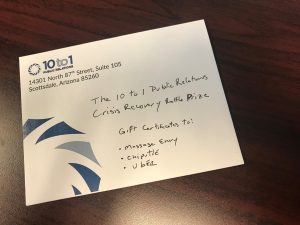
Our team recently attended an event where we supplied a raffle prize.  We decided to have some fun with it, creating a “Crisis Recovery Raffle Prize” which consisted of gift certificates from Massage Envy, Chipotle and Uber.  Three companies that recently faced different types of media crisis.

Yes, most attendees totally missed the joke but those that got it thought it was amusing like we did. As a public relations pro, it’s easy to focus on all the good news we create for our clients to grow their positive image and brand, but too many companies fail to prepare in advance for a crisis so that the can quickly deal with it should a media emergency occur.  Even fewer companies have a crisis recovery plan on the shelf ready to put in place whenever needed.

Let me share a few crisis examples that Businesses faced in 2017 where a crisis prep and crisis recovery plan would have been helpful.

Massage Envy: 

More than 180 women came out accusing Massage Envy franchise employees of sexual assault. The story broke in one news outlet and quickly became a national storyInitially the company didn’t respond and it took more than a day before the CEO made his first statement, which essentially said that a more thorough response would be coming in the following days.

Here’s the thing:  Massage Envy has more than 25,000 employees at more than 1,170 franchised locations.  They can’t be expected to know everything that happens during every customer interaction, in every locally owned franchise.  But they should have anticipated this kind of accusation would occur at some point, so they should have had a PR plan on the shelf ready to dust off and respond immediately.

From the outside, the company appeared completely unprepared.  While I do give kudos to what their team eventually said and tried to do to show they are working to stop future possible incidents, they simply didn’t act fast enough the slow or influence the spread of negative stories.  While nothing they could have done would have stopped a negative story, a faster response could have stopped or slowed the bleeding much earlier, creating less long-term risk to the company and making it easier for their brand to recover.

Uber:

2017 wasn’t a good year for Uber either. The number of issues they had is actually comical and likely will be taught in PR classes as a perfect self-created storm.  Early in 2017 they faced a #deleteUber campaign to protest actions which made it appear the company was siding with President Trump and his recently proposed travel ban.  After more than 200,000 people canceled their accounts, before the CEO was one of the last company CEOs to quit a Presidential council that helped slow the bleeding.

Shortly thereafter, a former engineer wrote about sexual harassment and gender bias at Uber. Her blog post claimed that her manager tried asking her to take part in his “open relationship,” then threatened to fire her for reporting it to HR. Making matters even worse, HR allegedly didn’t reprimand the man because he was a “high performer.”

As it that wasn’t enough, Uber CEO Travis Kalanick got into a fight with an Uber driver over falling fares. Dashcam video of the altercation went viral after being published by Bloomberg. Add on a data leak and a string of other issues – Uber logged a record-breaking quarterly loss, and several executives jumped ship, including Kalanick and President Jeff Jones.

Surely, it’s no easy task to handle one single crisis for a company of Uber’s magnitude… But the ridesharing company experienced several throughout the course of the year, displaying deep issues within the organization that needed to be addressed.

With new executives in charge of altering brand perception, hopefully 2018 will start (and end) with a much cleaner slate.  For that to happen, there needs to be transparency and a lot of time and effort spent on reputation recovery efforts.

They started that by trying to get all their dirty laundry out to the public, only a few weeks ago when the new leadership team announced that in 2016 the company paid off some hackers with $100,000 not to use stolen data from more than 57 million rider and driver accounts. My guess is if the new leadership finds anything else, it will be disclosed in the coming weeks and months in hopes that they can start from a clean slate.

Ultimately, will Uber be okay? I’d assume yes, but these crises definitely hurt their market share and their top competitor, Lyft, is said to be seeing a big boost thanks in part to Uber’s missteps.

Chipotle:

Chipotle has worked hard to recover from the E. coli outbreak in late 2015 that affected restaurants in 14 states.  While the number of people that got sick was actually low, the lost perception of Chipotle ingredients being healthier compared to other fast food services took a huge hit putting the long-term future of the entire company at risk.

It’s been a slow slog for Chipotle to regain the public trust. I know several people that still won’t eat there, or significantly curtailed how often they eat there.  But one also cannot deny that Chipotle has worked hard to implement new food safety protocols, hiring experts to direct the new program in an effort to reposition the chain as one of the industry leaders in food safety.  Just as sales (and their stock price) were steadily improving, Chipotle had relapse as one of their employees caused a norovirus outbreak at one location in Virginia in July.  Norovirus is a highly contagious illness, but it is was not food related.  The incident reminded the public of earlier incidents, renewing the perception of food safety problems forcing the company to take a few steps backwards before again trying to regain their past success and reputation.

What we can learn from these PR Crises –

Each of these examples are very different from one another. Some are cultural or self-imposed like Uber.  Others may come from the supply chain or a missed process like the initial E. Coli crisis faced by Chipotle. While other crisis might be somewhat predictable like the Massage Envy example.

No matter what type of PR crisis, it’s the failure to anticipate and prepare in advance that is the biggest risk to many companies.  A slow, poorly thought out response makes a story significantly worse than it already would have been.

The reality is that you can’t stop a negative story from occurring, but your actions can make the effects of a media crisis less damaging both in the short and long-term.

Have you ever thought about what possible (or even likely) disaster scenarios could happen to your company?

Are you creating a step by step guide of how you’d handle it if that scenario did occur?

Have you shared our plan or thoughts with your PR team or outside consultants so that they can vet the response strategy, provide feedback and know what to do if that story breaks?

Have you asked our PR team or outside consultants to start building that plan for you?

By planning ahead and being prepared, your efforts can aid and guide your company to a much faster reputation recovery and regain confidence to among your current and prospective customers.

note: Sierra Oshrin contributed to this blog

4 Reputation Management tips we can learn from Delta and Ann Coulter’s tweet storm last month

Quick reputation management has always been important for companies, but social media has dramatically sped up expectations.

Currently, some of the most known examples of threatened reputations are aimed at airlines where consumers are regularly posting to Twitter when unhappy about their service. Whether it be getting kicked out of their seat, not enough leg room, or their flight getting canceled; posting to social media is a major threat to the reputation of airlines—and ultimately to any company.

So how should a company respond when they’re receiving a tirade of nasty tweets from a disgruntled customer? Remember, whatever is posted online moves quickly and has the potential to last forever… So it’s important to handle these situations with grace, and good timing.

Here are four tips that will help a company manage its reputation.

  1. Pre-plan for different possible issues. Whether it be a reporter calling or something posted on your social media channels, have a crisis communications plan already in place so you can respond quickly.

Airlines must have lists of their most common complaints, and they also know which scenarios could be most damaging to them.  All they need to do if look at examples mishandled by their competitors if necessary.  Damaged instruments or sports equipment, lost wedding dresses, missed funerals, all these scenarios are easy to imagine occurring.  So instead of waiting to decide what to say during a crisis, pre-plan your responses.

  1. Acknowledge the issue quickly. Please note, acknowledgement doesn’t mean resolve the issue or give a full response.  If your company is still figuring out how to handle the situation, at least acknowledge that you’ve seen the tweet and you’re working to solve the issue.

Here’s an example. Just a few weeks ago, Ann Coulter made waves by tweeting that it took 28 hours for Delta to give her an explanation as to why she got kicked out of her seat. A tweet can go viral within hours – which means everyone who is following the situation is eagerly awaiting an explanation as well.  It’s no different than a forest fire- you wouldn’t purposely let it burn for hours before trying to put it out.  Imagine how quickly that fire would spread. An acknowledgement that you’re investigating the issue and will respond as quickly as possible won’t put out the fire, but helps contain it. It’s the waiting for acknowledgement and wondering if a company even knows of the complaint that often bothers people more than the time it takes to get a full response.

  1. Take the gas out of the bandwagon. It’s easy for people when they hear a negative story to then share their own negative experience. Stop this before it occurs.

The bandwagon effect occurs more quickly and regularly when it seems a company doesn’t care about a complaint.  Acknowledging an issue, then sharing publicly the resolution to that issue shows that a company listened and responded.  It doesn’t matter if everyone is happy with the resolution or result, but responding with respect and empathy goes a long way towards ending a stream of add-on negative impressions.

  1. Build up a good will bank so potential customers are more likely to give you the benefit of the doubt.

One of the main reasons Ann Coulter’s (or any angry passenger’s) tweets take off is because the public has gotten used to hearing about negative issues with airlines. Her incident wasn’t long after a United Airlines passenger got dragged off the airplane, or after a couple heading to their wedding claimed United kicked them off too. Both of these situations triggered social media onslaughts that hurt the company’s reputation.

What you don’t hear enough are all the good things these airlines are doing.  Yes, good news can go viral too—just look at the viral story of a stewardess saving a child from human trafficking, or how fallen soldiers are often respected on flights as a casket is being transported.  The trick is that negative news travels faster and wider than good news.  So it’s essential to build up lots of good will and positive stories to drown out any future negative story.

Conclusion:

Is the customer service with airlines progressively getting worse? Are people just more inclined to post about it now that they’ve seen their peers, celebrities, and political pundits do so? Who knows.  Either way it’s up to your company to build a good reputation before something negative is said, but also to manage and protect your reputation once that negative impression occurs.  Whether it be through a reporter’s news story, or a social media post.

By Sierra Oshrin, 10 to 1 Public Relations

The New York Jets have a “bridge” to sell you, and your spokespeople should be buying

Jets card of bridge messages side 1
Jets card of bridge messages side 2

Do you know how to pivot, or bridge a difficult or unflattering question from a reporter into an answer that puts your agency in a more positive light?

The NFL’s New York Jets recently gave their players a laminated card which phrases they could use to spin their answers.  New York Daily News reporter Manish Mehta took photos of one of the cards and tweeted it out.

Granted, it’s the Jets.  So they have been mocked mercilessly and it is embarrassing to the organization that the card has been seen by reporters and the public. But that doesn’t mean the idea of helping players bridge tough questions into positive answers is wrong.

Here are some of the “bridge” suggestions of how to transition from a difficult question to a more positive message:

  • Let me just add that…
  • That reminds me…
  • Let me answer you by saying…
  • Another thing to remember is…
  • If you look at it closely you’ll find…
  • The real issue here is…
  • That’s not my area of expertise, but I think your audience would be interested to know that…

Putting a positive spin on an embarrassing or negative story is part of the job as a spokesman, but it doesn’t stop there.  The reality is that every employee is a spokesman or public ambassador of the company.  The key is knowing what you want to say BEFORE the reporter even asks the question.

Let’s say that a company vehicle with your logo gets in a bad crash and media start asking questions.  An immediate response might be:  We’re investigating the cause of today’s crash involving one of our vehicles, but it’s important to note that our company has 50 vehicles on the road travelling more than 700,000 miles a year.  All drivers have passed a background and driving record checks, and have completed company driver training before receiving driving status to operate our vehicles. Once the investigation is complete, we’ll review the findings to ensure we’re doing everything possible to protect and care for our patients and the public.

In this simple deflection I provided lots of new facts and figures that could be included in a story.   If all I did was say the company was investigating, or acknowledge that the company driver caused the crash, the only thing the reporter can say is negative because they have nothing else to consider reporting or sharing within their story.

Sharing a silver lining in a negative story is completely appropriate, but let me be clear.  A spokesman should NEVER lie to a reporter.  Lie once and get caught, and you’ll never be trusted again.  There’s an adage that “crow taste better warm than cold.”  If your company or an individual employees makes a mistake, acknowledge it.

Think of it this way.  Fire fighters run into the fire, not away from it.  Your strategy should be the same for negative stories.  Put out the kitchen fire before it becomes a house fire.  I used to joke that when I served as the spokesman for an ambulance company, I hadn’t realized I was signing up to be a fire fighter because I’d spend most of my day putting out fires.  The faster you acknowledge and respond to a story that may be negative the better.  In acknowledging the mistake, explain what changes you’re making to help make sure similar mistakes don’t occur again in the future.

Pivoting to a positive response increases the options for the reporter to write a positive, or at least less negative, story.  More company spokespeople should memorize and carry a card like the Jets.

Looking for practical ways to practice?  Have a friend or co-worker start by giving you an obscure company fact or even a completely unrelated physical item—like aluminum siding.  Then, have the person ask you a question. The question doesn’t even need to be serious.  It can even by “why did the chicken cross the road.”  Your task is to logically, and conversationally transition the question of why the chicken crossed the road to an answer about aluminum siding.

Initially, it’s going to be difficult to make the transition feel natural and less obvious.  But after a little practice after you get comfortable using a bridge statement, it’ll become easy.  You just need to have the right players in position, practice and execute the game plan.  Just like the Jets.

p.s.:  For the record, no I’m not Jets fan.  Go Cleveland Browns (hometown)! Go Arizona Cardinals (home for the last 13 years)!