From Fashion to PR: My Journey of Transitioning Skills and Growing in Public Relations
Written by: Halle Sweeter, PR Intern
As the first-ever intern at 10to1PR, I have already learned so much about what a career in public relations really entails. The experiences that I have had in this internship have broadened my experience in the field. From day one I have gained a deeper perspective on what goes into the day-to-day responsibilities and importance of maintaining a brand’s image and the effectiveness that 10 good impressions can have in canceling out 1 bad one.
My first real encounter with PR came from a final semester project that was a co-collaboration marketing strategy between the fashion program at my school and a non-profit. In my pursuit of other education opportunities post-graduation, I knew I wanted a career that utilized my market research and trend forecasting skills while also combining creativity, strategy, storytelling, and relationship building.
My skills in market research and trend forecasting from my degree in fashion merchandising were put to use quickly and utilized in research and analysis for PR campaigns, client relationships, and contributions to group projects.
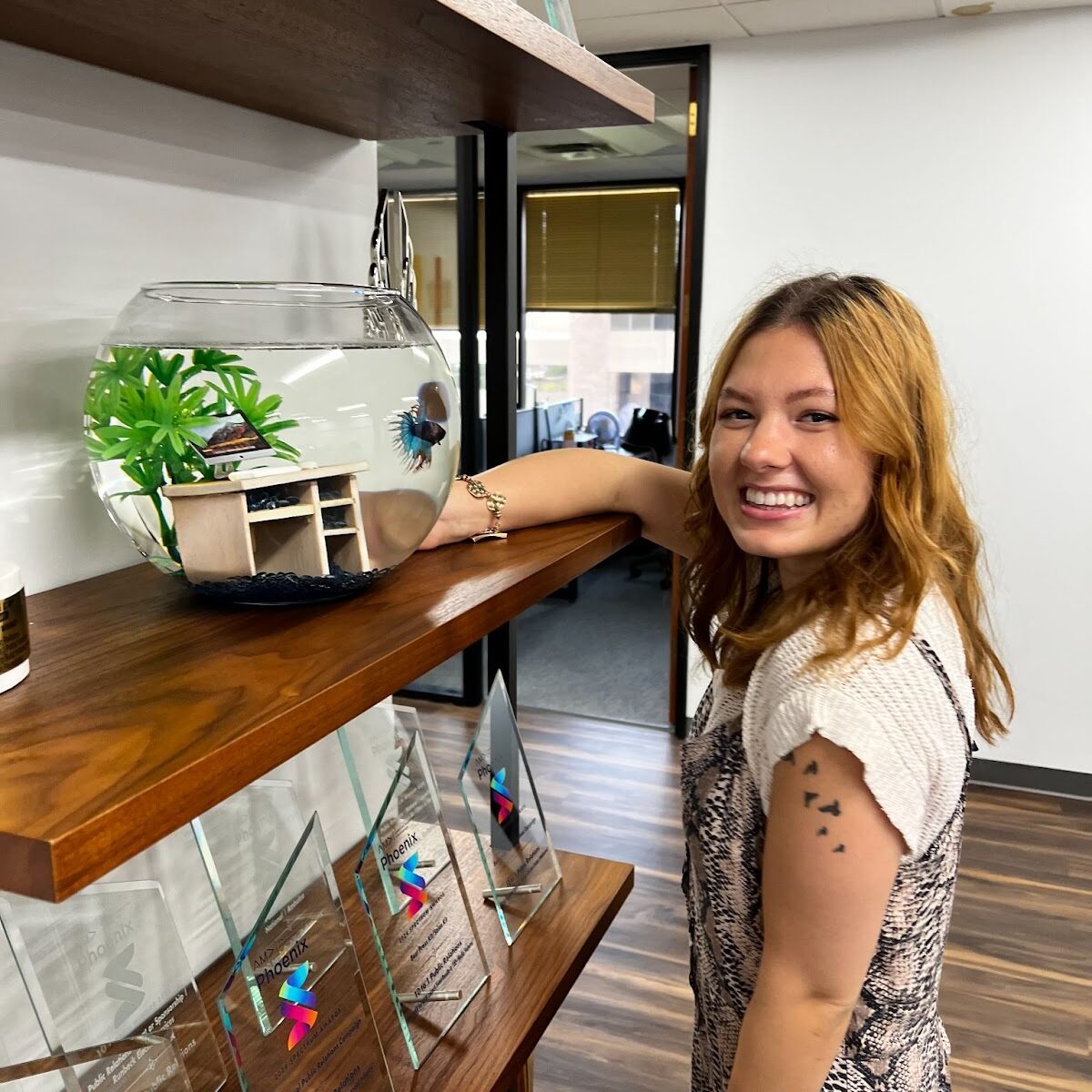
Halle with Drip, the office pet fish
Even from the day I came in as a shadow, I was given the opportunity to watch PR professionals at work. Through observing their work, I was able to gain hands-on experience and offer contributions towards meeting client goals, participate in internal strategy meetings, and learn best practices from team members on how to write more concisely.
Working at 10to1PR, I found a collaborative work culture where everyone has a specific skill they can contribute to the team. As a part of the team, I have contributed my skill set, as well as built a new one over the last 6 weeks. During the onboarding process, I started with basic tasks like feeding the office fish and setting up meetings, while gradually learning and observing from team members. As I gained experience my responsibilities expanded to include media monitoring, editing press releases, building media lists, and finally drafting my own press releases.
In college, professors teach you how to draft a press release and you can create as many mock press releases and pitches as you want, but no class can give you the rewarding feeling of sending your first real pitch to a news editor. And with a pitch-a-day campaign, I quickly gained confidence in my writing skills, and secured wins by getting multiple interview requests from reporters.
This internship has been a whirlwind of learning and growth, and taught me how my everyday skills could transfer over to a job in public relations. From administration tasks to major wins, every day has contributed to my development as a PR professional.
Attention Students: We’re Launching a PR Internship!
Are you passionate about storytelling and eager to dive into the dynamic world of public relations? 10 to 1 Public Relations, an award-winning PR firm, is thrilled to announce the launch of our new in-person PR Internship Program. This program is your gateway to gaining invaluable hands-on experience at the forefront of the PR industry.
Applications for our Fall Internship Program are now open, those details are below:
10 to 1 Public Relations: In-Person PR Intern Job Description
About 10 to 1 PR
Are you someone who likes to tell stories? Do you want to develop your talent while making an immediate impact as part of a team? Interested in gaining experience working at an award winning PR firm? Then we want you on the 10 to 1 Public Relations team!
10 to 1 Public Relations is a traditional PR firm that works with interesting and diverse business-to-business focused clients from across the globe. We have a “No Jerks” policy which refers to both co-workers and clients and we believe in a “no drama” office.
We are seeking a part-time, public relations intern to help our clients share their stories and achieve their public relations goals. Some of our work includes:
Media relations such as writing press releases, articles and pitching reporters and influencers (local, national and trade) and securing media placements (online, print, TV & radio)
New market and/or new product related media launches
Growing client recognition through award nominations and speaker submissions
You’ll be part of a team expected to play an important role in it all; involved in client-facing tasks, strategy creation, and implementation duties. Ultimately, you’ll gain real experience and be an important part of helping our team achieve the client’s stated goals, meaning you must:
Be able to prioritize, organize and manage multiple tasks at the same time
Have strong interpersonal skills to communicate with clients and journalists as well as collaborate with team members
Be an excellent writer
Enjoy telling stories
Summary:
A PR Intern at 10 to 1 Public Relations is a junior or senior college student in the PR field. This role is focused on gaining practical experience through hands-on work in public relations. The intern will support client teams, perform media monitoring, conduct client research, assist with administrative tasks, and work on a portfolio project. The ideal candidate should demonstrate strong writing, organizational, and research skills, and show a desire to learn about the PR industry.
For ASU students this internship would fulfill the requirements of JMC484, MCO484, MCO584 and MCO294.
Duration/Compensation/Logistics:
The internship lasts for an academic semester (start week of Sept 3, end date week of Dec 9).
The position is part-time, with a guarantee of 20 hours per week.
The pay is hourly at $16 per hour.
The weekly schedule is flexible around the intern’s class schedule, but work must be performed between the hours 9 a.m. to 5 p.m.
The intern is expected to maintain a consistent schedule throughout the program’s duration.
The intern is expected to be present for the entirety of the program, except the week of Thanksgiving when scheduling can be flexible to accommodate for travel schedules and hourly pay may be adjusted accordingly that week.
Internship is work from office 100% of the time. Remote work is not an option.
The intern is expected to provide their own transportation.
There may be an opportunity to extend the program or receive a full-time job offer, dependent on performance and need.
Competencies:
The PR Intern will be expected to develop the following competencies:
Engagement: Actively participate in team and client activities.
Proactiveness: Take initiative in tasks and responsibilities.
Ownership: Demonstrate responsibility for assigned tasks.
Passion: Show enthusiasm for public relations and learning.
Problem-Solving: Identify and address challenges effectively.
Critical Thinking: Apply analytical skills to tasks and projects.
Learning: Continuously seek to improve knowledge and skills.
Teamwork: Collaborate effectively with team members.
Timeliness: Manage time effectively and meet deadlines.
Responsibilities:
Client Relations:
Develop a thorough understanding of clients’ industries, business goals, target audiences, and challenges.
Support client meetings by taking detailed notes and observing client interactions.
Alert client leads and management to potential issues before they escalate.
Team Engagement:
Actively participate in internal team meetings and collaborate with team members.
Master and effectively use the team project management platform (Basecamp).
Deliver high-quality work on time, ensuring it meets company and client standards.
Document time spent on client and company projects daily using the time management system (Clockify).
Campaign Support:
Assist in the ideation and planning processes for PR campaigns.
Contribute new ideas that enhance campaign success.
Stay informed on news relevant to clients, including consumer media, business news, and industry-specific updates.
Support the execution of client campaigns as assigned by client leaders.
Manage assigned responsibilities, address challenges, and ensure campaign goals are met.
Draft and create PR materials as assigned.
Monitor media features using tools like Muck Rack and Google search; update media reports as requested.
Develop a strong foundation in media relations, including researching relevant media contacts and building media outreach lists.
Master the media relations platform (Muck Rack) and use it according to company standards.
Review daily media requests from sources like Qwoted, SOS, and other tools to identify opportunities and notify client managers.
Accountabilities/Relationships:
Reporting:
Report directly to the Internship Program Manager.
Report to the assigned client lead for specific tasks and assignments.
Communicate client and team successes and challenges to the Management Team.
Feedback and Performance:
Receive regular feedback from Internship Program Manager.
Receive 30-day, half-way point and end of program performance reviews.
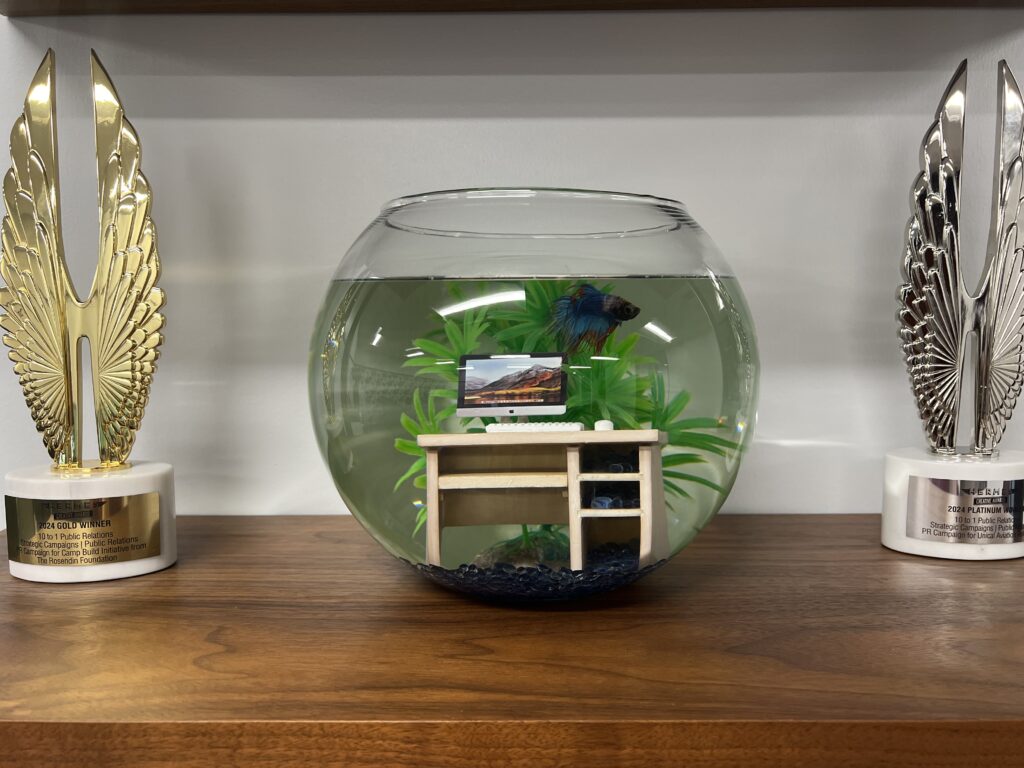
10 to 1 PR has a new team member: Drip the Beta Fish. Drip has become the beloved office pet, greeting our in-office team members every morning, blowing bubbles in support of our work, and offering general encouragement.
Drip’s Origin Story
Earlier this year, some 10 to 1 PR team members met to brainstorm ideas for April Fool’s Day. The group landed on the idea of surprising 10 to 1 PR President Josh with an easy-to-care-for office pet. Our resident fish enthusiast, Madeleine, secured the fish and the team surprised Josh for what was dubbed ‘April Fish Day.’
Get to Know Drip
Curious about our fishy friend? Here’s a bit more about Drip:
Where does the name Drip come from?
Drip was named for the 10 to 1 PR philosophy that our regular PR wins for our clients are like drips out of a faucet that contribute to a client’s positive brand reputation–slowly but surely, each drip accumulates to an overflowing bowl of water.
Where is Drip’s office?
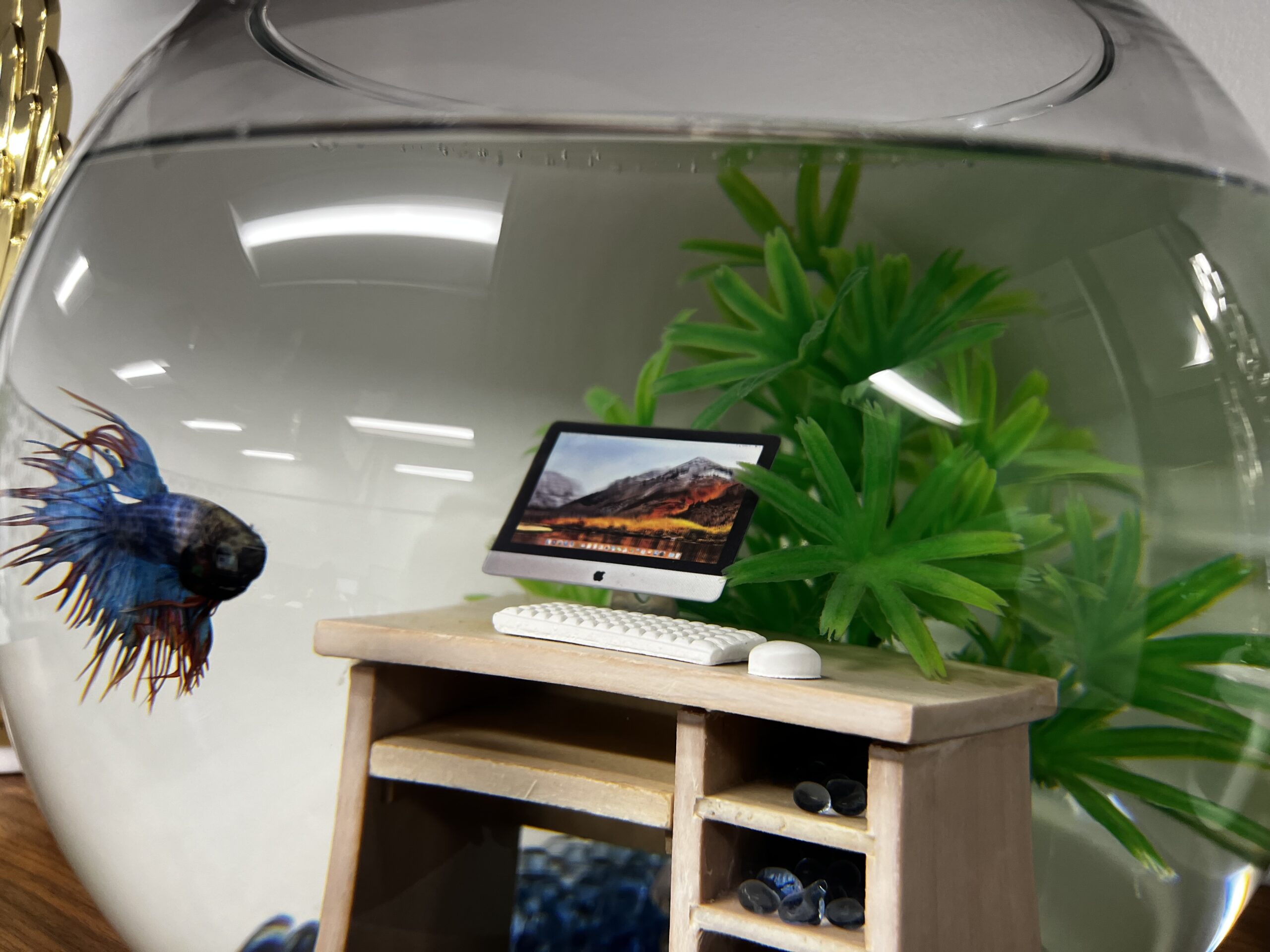
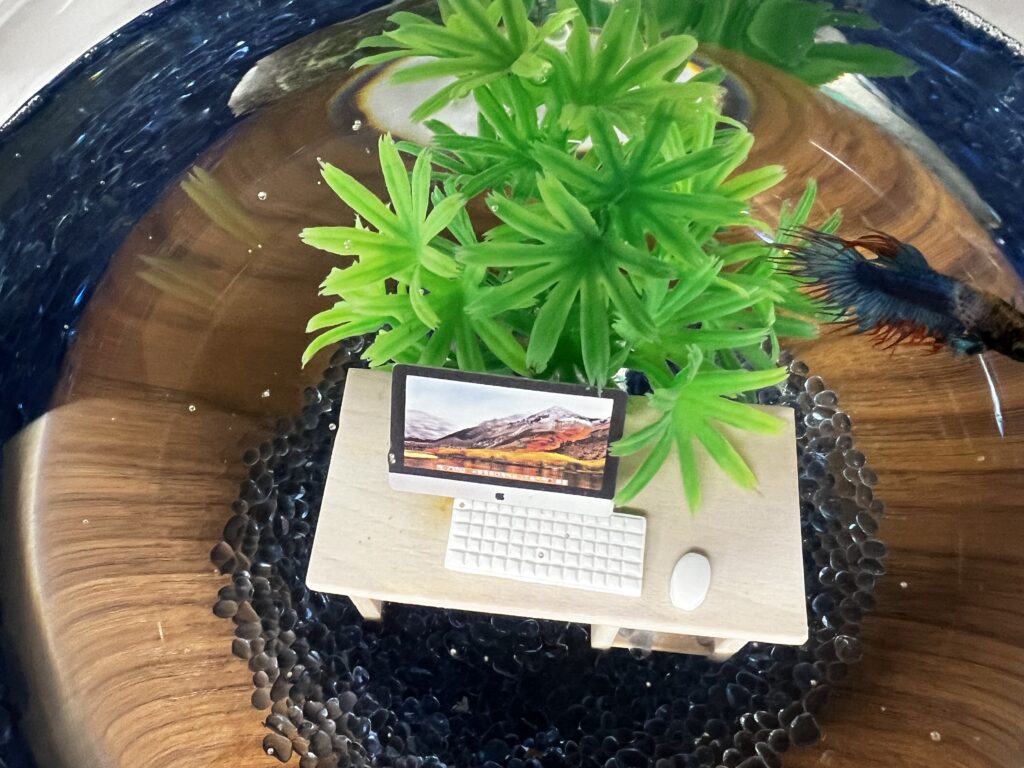
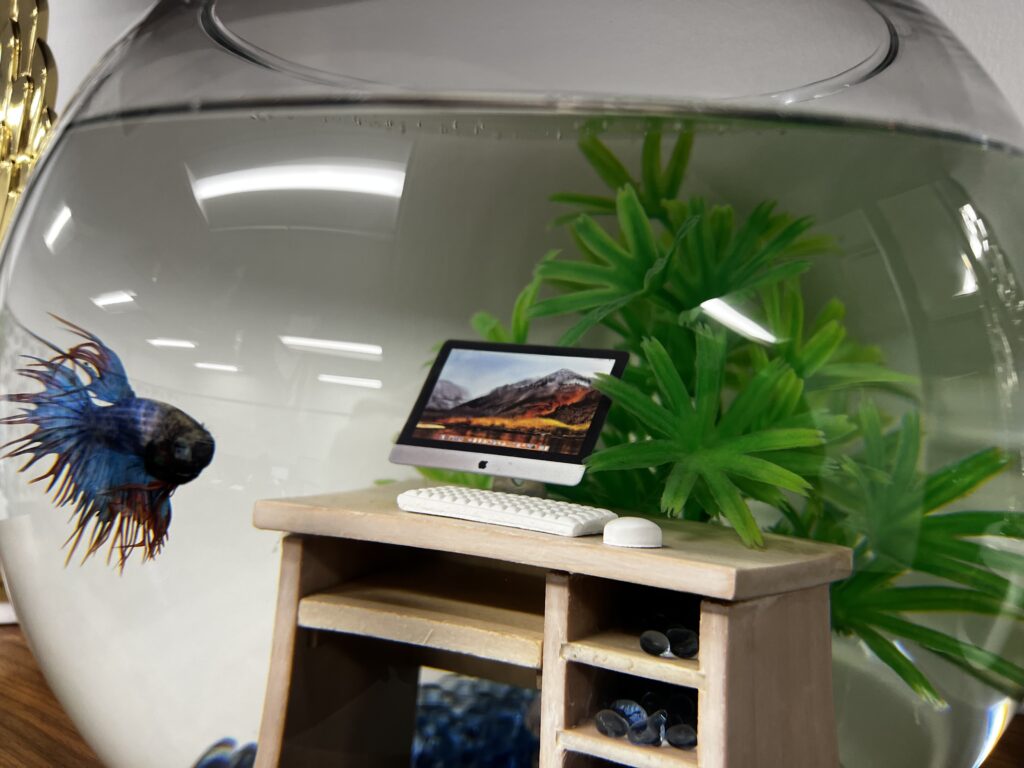
Drip has his very own desk and works amongst one of our office’s trophy display cases, where he has a great view of the entire office. He is very curious about all of the colors and reflections he sees.
What kind of computer does Drip use?
While the rest of the 10 to 1 PR team uses PCs, Drip has his very own Mac computer.
What kind of work does Drip specialize in?
Drip is a very productive member of the team, blowing an inordinate amount of bubbles every day. The bubbles collect at the top of his bowl, indicating he is pleased with his work.
Drip’s Next Adventure
What’s next for Drip? We’ll share a progress report on Drip and his contributions to the 10 to 1 PR team at a later date. Stay tuned!
Celebrating Women’s History Month by Honoring the Women Who Made Us (AKA Our Moms)
To celebrate Women’s History Month our team members each took a few minutes to write a summary describing women who inspire them in their daily lives and why. The survey results showed that every team member found inspiration from their mom. Moms influence people’s daily lives, and it’s the women of our family histories who ultimately helped shape our futures.
Drawing inspiration from mothers has a direct correlation to Women’s History Month, as it is an acknowledgment of the influence that women have on each other and how that influence is carried through generations. Below are some of our team member’s brief explanations as to why their mom inspires them and why they look to their mothers as role models.
Madeleine Williamson
My mom is my biggest role model. One of the greatest lessons she taught me is how to set goals and how to work to accomplish them. Watching her determination to try new things and challenge herself with new adventures has always inspired and motivated me to pursue my own goals. Currently, she is helping me train for my first marathon and is so supportive that she decided that she will train too and run it with me.
Lauren Dietrick
Two women in my life who inspire me are my mom and my sister. Their compassion, strength, and positivity inspire me to show up as the best version of myself. They are the first people I call when I need anything, from advice on adulting to unpacking the latest episodes of the shows we are watching.
Jamie Killin
My mom is my greatest role model – she is a semi-retired aeronautical engineer who grew in her career during the 1980s and 1990s when there were few female engineers, and continued to excel in her career even while balancing the demands of being a wife and mother. Not only is she skilled in her trade, she was a great manager and is the first person I go to when I need advice on how to be a better leader. Most importantly, she is a loving wife, a generous friend, a caretaker for her aunt, and a great Mom who’s never too busy to help me prune my roses, figure out my taxes or talk wedding planning. I just wish I would have inherited her math skills!
Rachael Clifford
A role model in my life is my mom. She is a hard worker who cares deeply for her family. She inspires me to practice empathy toward others and has helped me better understand the importance of fostering a positive environment and supporting those around me.
As technology advances AI has brought forth new challenges for businesses. Most recently the threat of deepfake attacks, AI-generated photos, images or audio files has increased, causing business leaders and employees to raise concerns about how to mitigate risk, protect themselves, and guard their businesses.
Below are three steps business leaders can take to prepare employees for a deepfake attack.
Be Transparent
Before a crisis happens, business leaders must prepare employees for potential risks. If a crisis hits, employees are most often the first ones who have to communicate with angry or scared customers– calming their fears and resolving their problems. Be transparent with your employees and let them know potential risks or threats that a deepfake attacker might take advantage of before it happens.
Examples of deepfake attacks can include the inappropriate use of AI-generated images or the spread of a fictional video on social media. A deepfake attack on a construction company can look very different than one on a dentist’s office. Employees are a company’s front line of defense. It’s crucial to be transparent, clear and upfront about company practices and threats.
Create Steps for Workers to Follow
Most companies already have a crisis playbook to guide them through incidents. If your company does not have a protocol in place for employees to follow in case a crisis hits, start building one immediately. When preparing for deepfake attacks, protocol should include educating employees on how to identify a potential deepfake. In addition, employees should know what to do if they suspect a piece of media is fake. Make the step-by-step guide short and easy to follow. If a crisis hits this protocol will help employees navigate the first 24 hours of a crisis until upper management can step in to provide more direction.
Schedule Trainings
Before a crisis company leaders should hold group meetings with employees to get everyone on board with key messaging and proper crisis protocol. Incorporate crisis messaging into monthly talks and urge company leaders to visit with employees to ensure understanding. Work with your company’s IT team to educate employees on how to identify if the media is a deepfake or not, similar to how companies conduct training on how to identify phishing emails or other scams.
Other Strategies
Other strategies for preparing employees for deepfake crises include preparing a crisis playbook and preserving media connections. Take action now and safeguard your business against deepfakes. Take a look at our free guide on how to prepare for a deepfake crisis.
Stop the Spread: Monitoring for Misinformation Will Save Your Business
Monitoring the internet for news mentions, customer reviews, and social media posts is a crucial part of maintaining a business’s reputation.
Businesses need to stay aware of what is being spread on the internet to mitigate risk, maintain trust and credibility, and support customer relations. Recognizing the spread of misinformation is key to building a strong defense against digital deception. It’s important to react to misinformation quickly and efficiently as misinformation can cause major business repercussions such as loss of customers and long-term reputation damage.
With the rise of digital deception, it is more important than ever for businesses to preserve their image to retain and gain customers. Reputation management through monitoring for misinformation safeguards trust and credibility for companies and is a key component of long-term success.
One strategy businesses can use to mitigate the risk of misinformation is to create an online space where customers can find and connect with your brand, such as websites or social channels or a website. If customers know the key messaging and tone of a brand they are less likely to confuse it with misinformation. In addition to creating an online space where customers can recognize a brand, maintaining that space is also crucial. Businesses should prioritize monitoring for misinformation while creating reliable messaging and sustaining engagement with customers.
Other strategies for maintaining reputation include preparing a crisis playbook and preserving media connections. Take action now and safeguard your business against deepfakes. Take a look at our free guideon how to prepare for a deepfake crisis.
At 10 to 1 Public Relations, we close our office between Christmas and New Year’s Day to give our team a well-deserved break after working diligently for our clients all year long. (Of course, we were on call to assist clients in need during that week in case of an emergency, of which there were a couple that we swiftly handled.)
We asked the team to report on what they were up to over the break, here is a snapshot of what a few of them shared:
Madeleine
Over winter break I flew to Santa Clara, California to celebrate my mom’s 50th birthday. While I was there I visited Wilder Ranch State Park, a relaxing area known for its beautiful hiking trails and and seal watching spots.
Madeleine Williamson, Sr. PR Coordinator
Rachael
I went on a hike and saw a coyote.
Rachael Clifford, Sr. PR Executive
Jamie
Over break I did a lot of home projects including having turf installed in the yard. My dog Piper was so excited!
Jamie Killin, Account Supervisor
Josh
I spent the holidays working hard for all our clients to resolve crises and coordinate interviews.
Josh Weiss, President
Erica
I went to visit the Christmas markets in Strasbourg, France, with my in-laws.
Erica Fetherston, Vice President
Joanne
I had an amazing time with my family celebrating Christmas and my daughter’s birthday on Christmas Eve.
Joanne Sgro-Killworth, Account Supervisor
Laura
Introduced my niece to conveyor belt sushi- she introduced me to mochi ice cream.
Laura Slawny, Vice President
Lauren
Went to watch some St. Louis hockey with my family and saw the Blues win an exciting game against the Dallas Stars!
Lauren Dietrick, Sr. PR Coordinator
Carolina
Had fun helping my nieces and nephews with their gingerbread houses, it was very competitive.
4 Ways to Preserve Your Business’s Image in the Age of Digital Deception
Digital deception is increasing and with today’s evolving digital landscape, leaders may be worried about maintaining their business’s image. It’s harder than ever for businesses to create trust and build relationships with customers, but with a little effort you can share your story the way it was meant to be told.
Here are four ways to preserve your business’s image in the age of digital deception.
1. Consistent Messaging
Messaging is how customers will recognize your company’s brand. If messaging is inconsistent, your target audience could become confused, ultimately leading to a decrease in customer traffic and a loss of trustworthiness. Make sure that messaging is consistent across all channels of communication, internally and externally, to ensure that customers can find your company, recognize your brand, and trust your products or services. In addition, it’s important to remember that consistent messaging should align with your brand’s mission, values, and key principles.
2. Crisis Management Planning
Creating a crisis playbook is a crucial part of preparing your business for unforeseen crises. Incidents such as data breaches, natural disasters, the spread of damaging viral videos and more can have a lasting impact on a company’s reputation. Having a well-planned crisis management plan in the form of a crisis playbook will allow you and your employees to respond to crises in a timely manner, reducing reputational damage and keeping customer and employee trust.
3. Media Relations
Building relationships with media such as reporters and editors will help ensure that your brand’s story is being told accurately. Making an effort to build a relationship with local or industry media will allow your company to be part of the media narrative that impacts the industry, local community, and more.
4. Monitoring Online Reputation
Monitoring the internet for news mentions, customer reviews, and social media posts is an important part of maintaining your business’s reputation. Creating an online space where customers can find and connect with your brand such as websites or social channels is a key aspect of creating a brand. Maintaining that space is crucial for sustaining engagement with customers and reliable messaging.
With the rise of misinformation and digital deception, it is more important than ever for businesses to preserve their image. Building a strong defense against digital deception includes preparing a crisis playbook, monitoring online presence, sharing consistent messaging, and preserving media connections. Reputation management safeguards trust and credibility for companies and is a key component of long-term success.
With the advancement of AI technology, businesses are seeing the emergence of new challenges and threats. A threat that has risen to the top of business leaders’ list of concerns is the threat of deepfakes. Deepfakes include the manipulation of videos, audio clips, photos, and other content for the purpose of misleading an audience or manipulating others into believing fake content is real.
The spread of misleading content can significantly damage a brand’s reputation and trust, causing a major loss of business. If you’re a business leader, you should be on the lookout for the following types of deepfakes and how they can affect your business.
Deepfakes and Financial Fraud
Financial fraud can be attempted through someone using a deepfake to appear as a trustworthy representative within an office. An example of financial deepfake fraud could be a voicemail left on an employee’s phone that sounds like their CEO or HR representative asking the employee to email over banking information for payroll reasons. However, in reality, the voice message is a deepfake, it’s an AI-generated message created to mimic a trustworthy person. This type of fraud is dangerous because an employee who has a lot on their plate or who is unaware of the threat of deepfakes might not think twice about confirming whether the request is legitimate.
Deepfakes and Impersonation
Impersonation is one of the most common types of deepfake fraud. Using AI tools, almost anyone can impersonate someone as long as they have access to photos, video, or voice recordings of them. Examples include the creation of an Instagram account mimicking the CEO of the company. The account may post photos of the CEO committing inappropriate actions, sharing extreme beliefs, or voicing unpopular opinions for the purpose of ruining the reputation of the CEO, brand or company. Impersonation is very dangerous for a business and can result in detrimental business loss and reputational damage, even if caught quickly.
Deepfake Impacts By Association
Sometimes, damage to a business’s reputation won’t be the main goal of a deepfake. However, many businesses in today’s world of viral videos and internet controversy will receive backlash through association. For example, an AI-generated video of a celebrity behaving inappropriately at a public event wearing a hat with the logo of a business could appear funny to viewers at first, but when spread can cause major repercussions. As viewers dive deeper into the video they can acknowledge the celebrity’s hat and the business it represents. This is just one simple example of how a business can be pulled into a crisis, incidents where businesses deal with repercussions because of association happen all the time and leaders need to be ready.
Deepfakes and News
Deepfake fraud in the form of a news story can spread far fast. It is arguably one of the hardest crises for businesses to stop once started. For many reasons, creators of this type of fraud spread illegitimate content appearing in the form of news articles or updates. Deepfakes like this can be dangerous as news outlets will sometimes pick up stories others have published, resulting in false information being shared. For example, an AI-generated video of an employee protesting in an extreme way is shared online and then shared via social media. Social media users may not realize the content is a deepfake and continue sharing. The video was fake from the start and users may eventually realize that, but now it is too late.
Ways to Combat Deepfake Fraud
Businesses need to be prepared for the threat of deepfakes and deepfake fraud. Some ways businesses can prepare for this challenge is by making sure employees are aware of the threat of deepfakes and are educated on how to tell if a piece of content might be deepfake fraud. In addition, businesses can increase digital security, keep media identification tools on hand, and create internal business strategies on what to do if a threat ever happens.
At 10 to 1 PR, we have secured agreements with highly reputable deepfake detection software companies capable of conducting immediate reviews of content in addition to creatine strategies and crisis playbooks for businesses to help prepare for the threat of deepfakes. We also have connections to AI Deepfake industry experts willing to provide their personal insights to the media and the public, exposing the deception.
Take action now and safeguard your business against deepfakes. Take a look at our free guide for how to prepare for a deepfake crisis.
How to Leverage Community Outreach Initiatives for Positive Brand Awareness
Written by Annie Appleton, PR Executive at 10 to 1 Public Relations
Corporate social responsibility, such as community outreach and charitable work from a business, has long been a tool used by public relations professionals to help bolster an organization’s reputation. There are a lot more benefits that can come from performing community outreach projects other than being a positive story to feed to the media. We’ll run through some of those benefits, plus how to turn a community outreach initiative into a PR win.
Why Community Outreach Matters
Performing community outreach is a great building block for positive brand reputation and recognition. Having strong community outreach initiatives also helps build trust between the business and the community. It shows that the business cares about its community and the people in it, thus helping to create a more loyal customer base. This also reigns true internally for the business or organization.
“Roughly 82% of U.S. consumers actually consider corporate social responsibility when deciding what services and products to buy and from where. Similarly, a survey of millennials’ work habits indicates that 86% of Generation Y workers greatly value their companies’ corporate social responsibility programs and would quit their jobs if those programs started to slip.”
We are seeing more and more from both an external and internal standpoint that people care about what values a business stands on. People are choosing where to work and shop in businesses that align with their own core beliefs. With the rise of social media, audiences can determine by one post if they will support a business or not.
How to Identify Relevant and Timely Causes
The first thing we look at when start to think about a community outreach initiative is the calendar. We review what holidays are coming up, what time of year it is, and what is timely. For example, in June, a community outreach effort could be centered around Father’s Day, Pride Month, or summertime.
The next thing to consider is the who, what, and why:
Who in the community needs help
What are we going to do to help
Why we chose this particular problem to solve
Finding a cause or organization that is relevant to your business is a good place to start when it comes to deciding the “who.” Here in Phoenix, AZ, it gets hot in the summer. For those who haven’t experienced it, imagine walking into an outdoor wood-fired pizza oven. It is like that, only hotter, from May – October. Homelessness is a big issue here, caused in part by not enough affordable housing and an unstable economy. Here is why the who, what, and why come into play:
Who: People with little to no access to shelter from the heat
What: We will host a water drive by donating cases of water to an organization
Why: According to reports at least 130 people experiencing homelessness died from heat-related deaths in 2021
Getting PR Recognition for Your Community Support
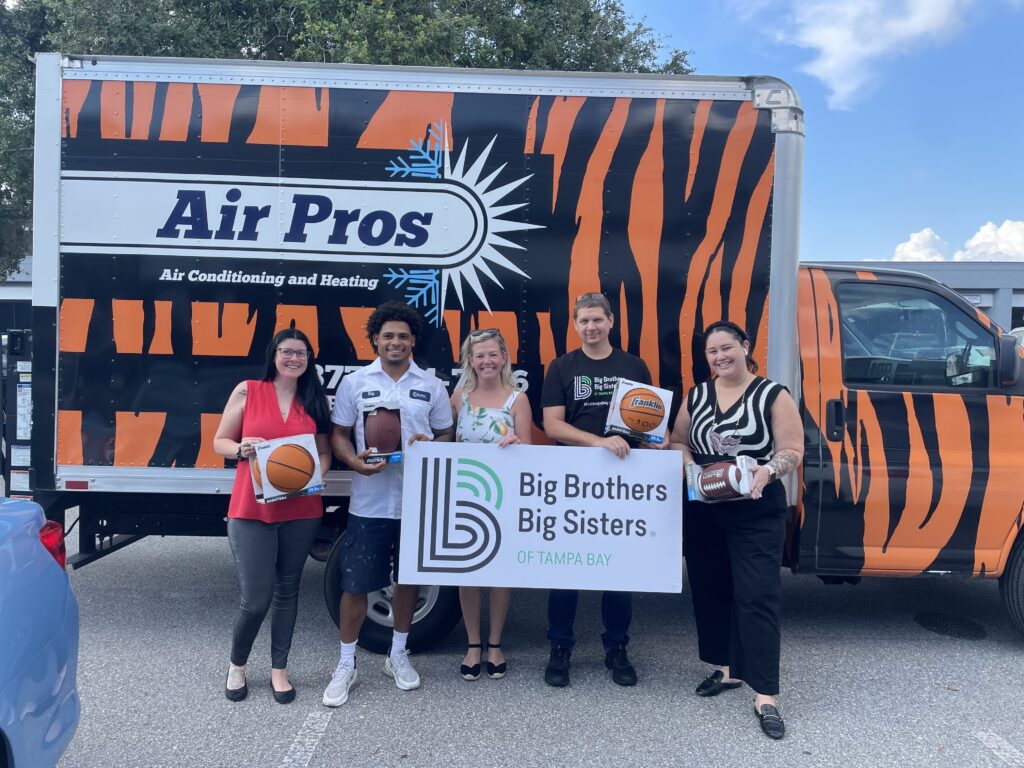
Our client Air Pros collaborated with their local Big Brothers Big Sisters organization on a donation to support kids in the community.
Once you have identified your cause and how you are going to help, there are several things you can do to leverage the work you are doing for positive public relations. Consider:
Creating an event around your community outreach project.
Make sure to take photos with your company’s logo visible
Invite the media to your event and offer interviews about the cause
Send a post-event story (along with your photos) to the media
Add how your company practices corporate social responsibility to the company website
Post your photos and community outreach projects on social media
The Big Picture: Impacting the Community
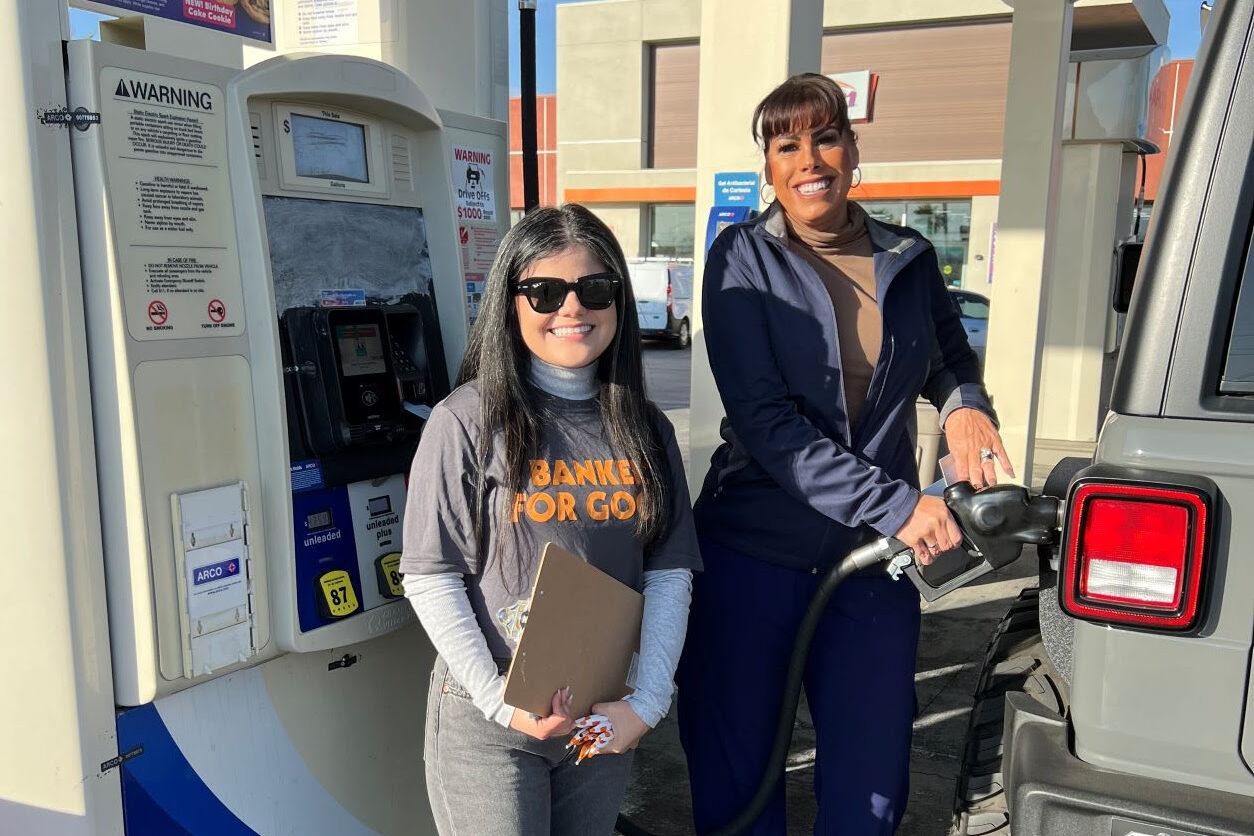
We worked with our client FirstBank to create the ‘Give it Forward’ campaign to raise awareness for donating to local nonprofits for Coachella Valley Giving Day and Arizona Gives Day.For this year’s campaign, FirstBank surprised local residents by covering their gas bills and encouraging them to ‘give it forward’ by donating to a nonprofit of their choice.
Most importantly, community involvement helps the community at large. When performing acts of service there are real people in real need that are the most important beneficiaries. Think about a back-to-school supply drive. Those who benefit the most will be the teachers that often have to buy supplies for their classrooms out of their own pockets, and the children who will have the supplies they need to learn. That should always be the main focus of a community outreach project, not how it benefits the business doing the service, but how it benefits the community.
The internal benefits of community involvement are vast. These programs and projects are wonderful for team building and unifying employees. They get the whole team to work on one goal – helping others. It can help raise employees’ morale as well. If employees are given a voice on what projects and issues are important to them, it can leave them feeling not only more professionally fulfilled but also fulfilled on a personal level. Many businesses and organizations choose to schedule volunteer days where, instead of going to work, they volunteer at an organization for the day. This gives the employee more control to choose a cause close to their heart.
Takeaways
Taking part in community outreach programs is a wonderful way to practice corporate social responsibility. Community outreach can help to build brand recognition and reputation, foster trust with customers and the community, and bring a team closer together. But when we look at the bigger picture practicing corporate social responsibility by helping the community around us is invaluable to the community and the individuals that are at the receiving end.
We should all try to leave the world a little better than when we arrived. Companies are no exception. There is so much good that can be done in the world, so many people that could use a helping hand, and not enough people that are willing to extend that helping hand. I encourage you to go out and be involved in your communities, and strive to be the good in the world, you will be surprised how even the smallest of things can make an enormous difference in the lives of others.